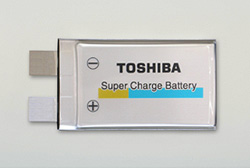
Toshiba Corporation today announced a breakthrough in lithium-ion batteries that makes long recharge times a thing of the past. The company’s new battery can recharge 80% of a battery’s energy capacity in only one minute, approximately 60 times faster than the typical lithium-ion batteries in wide use today, and combines this fast recharge time with performance-boosting improvements in energy density.
The new battery fuses Toshiba’s latest advances in nano-material technology for the electric devices sector with cumulative know-how in manufacturing lithium-ion battery cells. A breakthrough technology applied to the negative electrode uses new nano-particles to prevent organic liquid electrolytes from reducing during battery recharging. The nano-particles quickly absorb and store vast amount of lithium ions, without causing any deterioration in the electrode.
The excellent recharging characteristics of new battery are not its only performance advantages. The battery has a long life cycle, losing only 1% of capacity after 1,000 cycles of discharging and recharging, and can operate at very low temperatures. At minus 40 degrees centigrade, the battery can discharge 80% of its capacity, against 100% in an ambient temperature of 25 degree centigrade).
Toshiba will bring the new rechargeable battery to commercial products in 2006. Initial applications will be in the automotive and industrial sectors, where the slim, small-sized battery will deliver large amounts of energy while requiring only a minute to recharge. For example, the battery’s advantages in size, weight and safety highly suit it for a role as an alternative power source for hybrid electric vehicles.
Toshiba expects that the high energy density and excellent recharge performance of the new battery will assure its successful application as a new energy solution in many areas of society.
The prototype battery is small and light and offers a high level of storage in a 3.8mm thick, 62mm high and 35mm deep package with a capacity of 600mAh. These characteristics assure the wide applicability of the battery as a power source for products as diverse as hybrid vehicles and future mobile phones.
Link: PalmInfocenter.com.
Comments
6 responses
I fligh model airplanes. 3.200 mAh Lipo cels are state of the art now a days.
Think it through.
80% of 3.2 Ah in one minute. 153.6 A to charge it.
You need welding equipment to recharge.
I like it 🙂
Okay now its Li-ion, bit heavier and 600 mAh but they will grow…
Greetings,
Henri
I know you said the battery will be available in 2006 but that is so I ideal to get now. I run 1/10 scale gas cars and I use 830 mah lipo pack which is 42 grams 53mm by 38mm by 11mm. It would be lovely to get that toshiba super charge battery. What would it continuous discharge be, and what charger would you recommend to use. Also how many volts is that supercharge battery. One last thing, what would be the dimensions and specs on a 830 or higher mah battery? Thank You for Your Cooperation. SaintArpus@Comcast.net
Does anyone have any idea what ever happened to this wonderful battery????
same question..where is it ..its nearly 2007
I’ve read on forums somewhere a response from Toshiba I presume. It stated that it would be released in 2008. The battery was only announced as a possibility in 2005, and you know how large companies work. How many staff does it take to fix a lightbulb, and how many desks does the paperwork pass over… retorical question, all of them.
So anyways, for now there is the M1 from http://www.a123systems.com/
When this is released, it will beat the M1 by roughly 20%. There are other proposals that would beat this one out, but they’re still a little ways off.
Well here we are in 2008, and still no word from Toshiba and the release of this new tech. The Chevy Volt is testing batteries from LG Chem and A123 Systems, who have both been developing Li batteries for these applications for a while. I think that if Toshiba had what they promised in 2005 right now they would be right there with the other manufacturers. It sounds like this is a case of “our reasearchers think this is possible so we will release info to make people think that we already have the tech available”. Oops, maybe they were a few years premature.